The best version of Society 5.0 is not a world where AI replaces people.
It is a world where AI helps more people participate.
Japan’s Human-Centred Vision
Japan’s official vision is explicit that Society 5.0 should be human-centred, sustainable, resilient and supportive of diverse well-being. That framing matters, because it tells us the role of AI is not domination. It is service.
This becomes even more important when AI moves closer to the human body and mind.
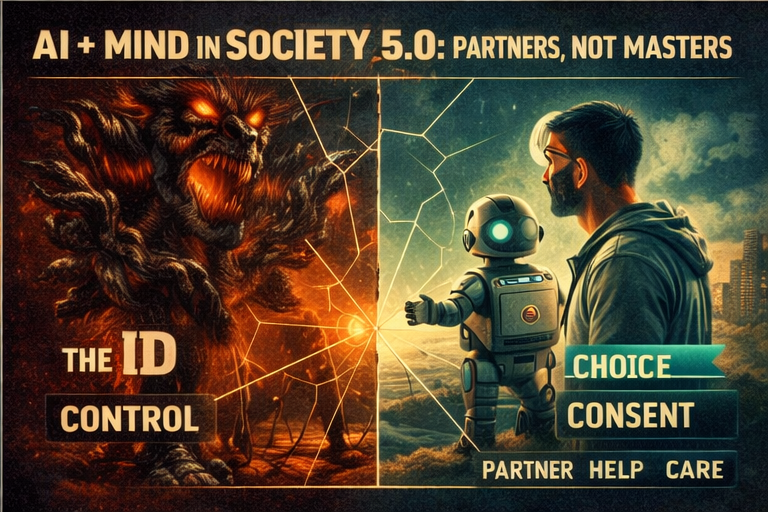
AI as a Remarkable Partner
In care, disability support and communication, AI can become a remarkable partner. It can:
- Interpret weak signals from people with limited ability to communicate
- Personalise environments to support individual needs and preferences
- Simplify interfaces for people with cognitive or physical limitations
- Help someone choose, speak, remember and connect
- Provide continuity of care and presence without replacement of human relationship
But it must never become a master.
The Ethical Boundaries That Matter
That is why future-facing systems need clear ethical boundaries:
- Consent — Users and their advocates maintain control over engagement
- Mental Privacy — Inner thoughts and impulses are protected from surveillance
- Cognitive Liberty — The right to think without external influence or coercion
- Human Override — Ability to stop, pause, or redirect AI-assisted processes
- The Practical Right to Disconnect — Systems designed so users can actually leave, not just theoretically
These are not abstract ideas anymore. They are already central themes in current OECD and UNESCO work on neurotechnology ethics. The frameworks exist. The question is whether AI development will follow them.
The Formula: AI With Human
So the right formula for a healthy Society 5.0 is not:
AI over human
It is:
AI with human
That is the deeper promise of your framework:
- Society 5.0 gives the smart social environment
- Web5 / NeuroConnect gives access to it
- The Forbidden Planet principle gives the boundary that keeps it humane
A better society will not come from intelligence alone.
It will come from intelligence guided by dignity.
What This Means for Care and Connection
In practice, this means:
- A person with aphasia using AI communication support knows the system serves their voice, not replaces it
- An elderly person in care has AI that simplifies daily tasks without surveilling their thoughts
- A neurodivergent individual can use cognitive support tools that enhance their capabilities, not constrain their autonomy
- Someone with a physical disability gets environmental assistance that expands their choices, not limits them
- Every person retains the right to refuse, disconnect, and remain fully themselves
The difference between these outcomes and dystopian alternatives is not complexity of technology. It is clarity of values.
See Also
Explore related frameworks:
- From Society 5.0 to Web5 — How digital sovereignty connects to human-centred AI
- Why Society 5.0 Needs an Off-Switch — The critical importance of the right to disconnect
And for deeper context on safety principles: The Forbidden Planet Principle — Ethical guardrails for advanced mind-machine interfaces.
Ready to explore the future of human-centred technology? Discover our available domains or contact us to discuss Web5 and Society 5.0 strategy.